The industrial cybersecurity we knew for decades is over. That was the thesis with which Juan Marino, Regional Manager Latam Security Partner of Cisco, closed the morning of the Industrial Cyber Summit Argentina 2026 Before lunch, with a question designed to be uncomfortable: «Are we facing the end of security?» The answer she developed over twenty minutes was neither optimistic nor pessimistic. It was philosophical, honest, and more disturbing than any incident statistics.
The word «end» has two meanings, and Marino used both. The end as finiteness (something that ends, that reaches its limit) and the end as purpose, as an objective. His argument was that both things are happening simultaneously: the model of security based on total control has reached its limit, and at the same time it is necessary to redefine what security is for if it can no longer be that control.
The paradigm that fell: from deterministic to probabilistic
During the morning of the event, two words appeared repeatedly in various talks: deterministic and probabilistic. Marino took them up again to structure the diagnosis. For decades, security has operated under a deterministic paradigm: if you do the controls well, you can predict and prevent incidents. That model worked as long as the environment was relatively stable and the systems relatively isolated.
That world no longer exists. Attackers operate on probabilistic logic — they test, learn, adapt — artificial intelligence has exponentially accelerated that capability, and industrial and IT environments are so converged that a phishing email can, under poorly segmented networks, even shut down an entire plant.
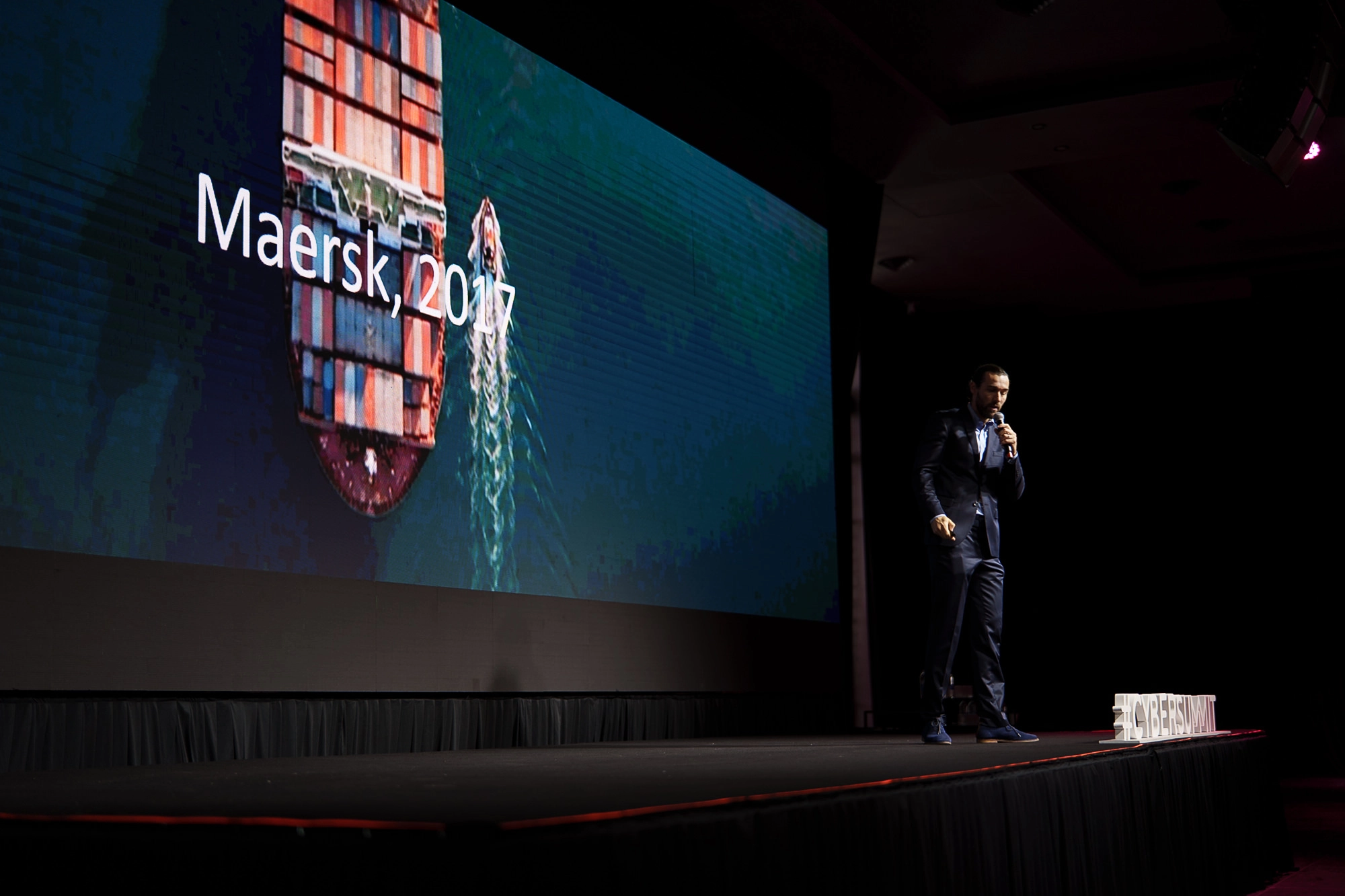
To illustrate the scale of the problem, Marino cited the incident that Maersk suffered in 2017 with the NotPetya malware: almost 50,000 devices stopped working in seven minutes. Global maritime logistics came to a standstill. It wasn’t the ships, the ports, or the oceans that failed. It was the software. And that kind of cascade, which in 2017 took days to contain, in 2026 can happen at the speed and scale enabled by artificial intelligence applied to finding vulnerabilities in code.
The problem that AI accelerates and that it can also solve
One of the most revealing passages of the talk was when Marino described what Anthropic did before launching one of its tools with the ability to search for vulnerabilities in code: calling together a dozen industry players—Cisco among them—to work on hardening their own infrastructure before the tool was made available to everyone. The reason was simple and disturbing: they knew that what they were building could be used as a weapon.
That logic applies to all the AI agent models that are coming to the market. What speeds up the search for vulnerabilities for defensive teams, it speeds up the same proportion for attackers. And the time window that exists between a vulnerability being detected and attackers exploiting it—which was already tight—is being compressed to almost zero.
The data that Marino put on the table to measure the gap comes from a study by Cisco: only 3 out of every 100 companies have a high level of maturity in cybersecurity. The remaining 97% operate at medium or low levels. That, in an environment where the surface of attack grows faster than the defense capacity, is not an encouraging statistic.
Cisco’s response to the malicious agent problem was to launch Defense Cloud: an open-source defense-oriented platform, as a direct response to OpenClock, a tool that enables the use of agents—both for legitimate uses and for attacks. The logic is to use the same open collaboration logic that makes attackers strong to strengthen collective defense. Paradoxically, the best way to protect the world from agents is to use defensive agents.
The weight of the CIO's shoes
Marino focused on something that few technical presentations address: the human cost of leading cybersecurity in an organization. He did so through the case of Joe Sullivan, who was Uber’s CISO and was found guilty in court for how he handled a ransomware incident, including paying a ransom that federal justice interpreted as cover-up.
Marino did not go to judge Sullivan. He went to point out something more structural: the ruling placed all the responsibility on the shoulders of a single person, in a context where organizations rarely give the security area the support it needs to operate with real autonomy. And he asked the CISOs present in the room if they would trust that, after a serious incident, their superiors would pat them on the back and tell them that it could have been worse. The silence was eloquent.
The problem is cultural, and Marino went straight to naming it: as long as security is not seen as an enabler of business—as the condition that allows services to continue functioning, that the economy operates, that people can trust the systems they use—it will continue to be treated as a cost to be minimized and the CISO will continue to shoulder the consequences that are the responsibility of the entire organization. That connects directly to the argument that State panel He developed the need for the cybersecurity sponsor to always be at the highest level of leadership.
The network as a critical infrastructure of the AI era
The second half of the talk was more technical but equally strategic. Marino argued that we are entering what he called a «supercycle of networking»: a period of radical expansion in network demand driven by AI. Until now, even with chatbots and language models, traffic maintained certain recognizable patterns. When AI agents start operating on a scale (communicating with each other, generating requests in parallel, processing volumes of data that are unprecedented), network demand will multiply in ways that current architectures are not prepared to support.
That makes the network the critical infrastructure of the AI era, and its protection a problem that goes beyond the firewall and SIEM. It requires an architecture designed from the outset for that scale, and management that can no longer be manual. Cisco’s response is what they call «cloud control»: an AI-based network and security management, where the operator interacts in natural language and makes final decisions—the concept of «human in the loop» that permeated all the talks at the event.
The environmental dimension also came into the conversation. Global data centers consume 400 billion watts of electricity per year (1.5% of global energy consumption, equivalent to 40 million households) and require 560 billion liters of water per year to stay cool. A single query in an AI chat consumes approximately 65 Wh, comparable in energy to cooking a steak on an electric grill. The expansion that comes with the agents will multiply those numbers, and the design of the infrastructure that supports that demand has to consider energy efficiency as an engineering requirement, not as a declaration of intent. Silicon One, the chip that Cisco is integrating into the core of its network architecture, aims exactly at that: more performance with less energy consumption.
Eutopia: the possible ideal
The closing of the talk was the most original part of the event. Marino proposed a word that occupies the space between utopia—the impossible ideal—and dystopia—the future that cinema taught us to fear. The word is eutopia: a possible ideal, something we can build if we make the right decisions.
What connects that idea with the Cybersecurity in critical infrastructures The fact is that protecting systems is not an end in itself. It is the prerequisite for other things to happen: that energy flows, that hospitals provide care, that people can trust the services that support them. In that sense, security is neither a cost nor a restriction. It is the invisible infrastructure that makes everything else possible.
The final definition that Marino closed before lunch was precise: «The end of security is protecting the possibility of trust.» Not the systems. Not the data. Not the processes. The possibility of trust. In a world riddled with autonomous agents, vulnerabilities that are exploited in minutes, and decisions that rest on people who carry a huge burden, that is perhaps the most honest definition the sector can give itself.
Read also: Cybersecurity in the industry: when ransomware learns faster than defense and Hybris, Achilles and the Trojan Horse: culture and OT security in the industry